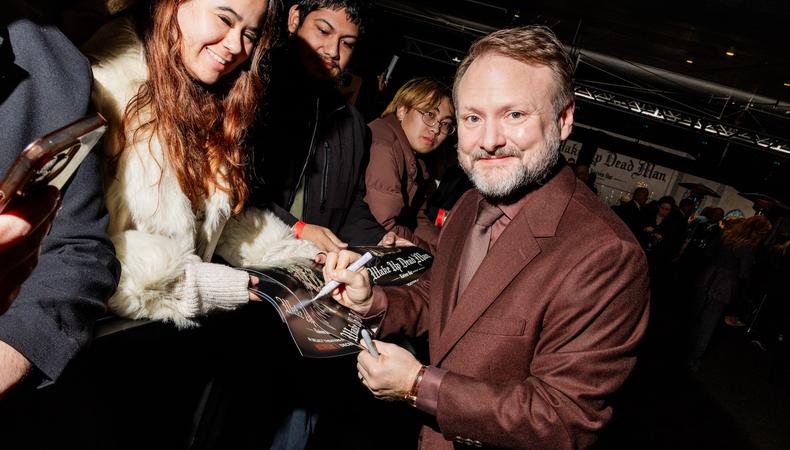
In the case of the “whodunit” genre making a major pop culture comeback, the guilty party isn’t much of a mystery. Rian Johnson almost single-handedly reintroduced Agatha Christie–style storytelling thanks to his 2019 mystery-thriller “Knives Out,” featuring the Southern-accented sleuth Benoit Blanc (Daniel Craig) at its center. Two Netflix sequels followed, both bringing back Craig’s detective: 2022’s tech bro–skewering pandemic puzzle “Glass Onion” and, most recently, “Wake Up Dead Man: A Knives Out Mystery.” The latter finds a young priest (Josh O’Connor) enlisting Blanc’s help after the murder of a firebrand monsignor (Josh Brolin) and the subsequent shady dealings of his constituents—an ensemble that includes Glenn Close, Andrew Scott, Jeremy Renner, Kerry Washington, and Cailee Spaeny.
With “Wake Up Dead Man” hitting Netflix on Dec. 12, we sat down with Johnson to dig into the secrets of crafting impossible mysteries, building the perfect ensemble, and directing actors. Check out the full interview in the video below.
I just happened to notice you got a “special thanks” credit on Guillermo del Toro’s “Frankenstein.” How’d that come about?
I played the monster in the movie. [Laughs] No, Guillermo and I are buddies. I was lucky enough to see a few cuts of the movie through the process and just gave him some feedback. He was very, very kind, giving me that credit. I love that movie so much; to have my name at the end was pretty nuts.
I’ve seen you say that all of the “Knives Out” movies are incredibly personal to you. For any aspiring creatives, what have you found to be helpful in making big entertainment that still feels personal?
For me, and increasingly so as I get older, forcing myself to delve into those personal elements is the thing that actually drives [a project] for me. It’s the thing that actually makes me excited about making anything. The craftsmanship of trying to entertain and engage an audience—I can’t imagine making a movie without doing that, but I also can’t imagine making a movie just doing that. There has to be something personal, because there has to be something scary. There has to be something that I’m not sure I can pull off. The day I dread is the day where I’m doing something and I feel like I know how to do it. That’s creative death.
With “Wake Up Dead Man,” to talk specifically, on the genre level, there was a notion of doing an impossible crime—which I’ve never attempted, and it’s never, for me, really been done well in film form. It’s something that’s very difficult to do visually. So that felt challenging, but the real thing that drove me was this notion of making the whole thing about faith. I grew up very Christian. I’m not a Christian anymore. I have a very multifaceted, complicated, intense experience with faith in my life, and I had an idea of: Can I have this conversation—not a didactic message—but a conversation about this topic? And not just hide it underneath a big, entertaining whodunit, but use the mechanics of a big, entertaining whodunit to amplify that conversation?
I start with genre, and then try to get personal with it. Like in [2012’s] “Looper.” The notion of having a father and son sitting across from each other, and the son saying “I’m not going to turn into you”—that’s a powerful scene that we all recognize. And then to use a time travel movie so you can literally have a younger self and an older self doing it, that projects it up on a wall and intensifies it.
We had Daniel Craig on our podcast, In the Envelope, and we got to talking about how he likes to be directed. He said, and I want to quote him directly, “I want very specific notes, but I also want you to leave me the fuck alone.” Does that track with you, having directed him in three “Knives Out” movies?
That absolutely tracks. But when he says that, it sounds like he’s bristly or something on set; he’s not. He’s warm, he’s engaged. You walk up to him, he’ll always engage. That having been said, I feel like the more films I make and the more I work with truly great actors, the less that I say to them. I find myself, when I give direction, trying to be as precise as possible. You realize, especially with great actors, that less is more in terms of direction. Really, it’s your job to sit at the monitor or behind the camera, have an emotional reaction to what you’re seeing, and then parse that and react to it. Be an audience member for them. Then give an adjustment, if there’s something that you can clearly define.
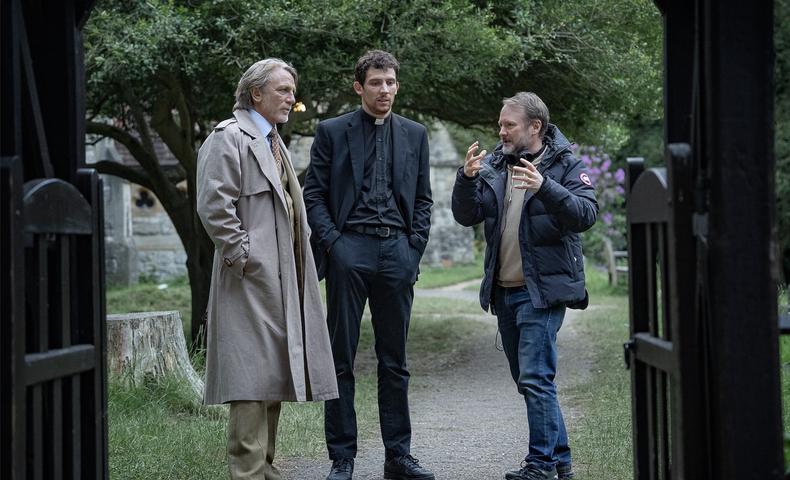
In my brief time speaking to Daniel Craig, I would say “he sounds bristly but he means it warmly” is very accurate.
Oh yeah, and also he’s right. I think it applies to every good actor. So much of the work of directing has happened already on the page, and in casting and choosing that person. So much of the work of acting is internal. That can’t happen when you have some director squawking at you and giving you a theory of the scene or something. It’s all about them going into themselves and finding a truth.
The “Knives Out” movies really demonstrate the art of building an ensemble. I want to talk about a few of your “Wake Up Dead Man” cast members and what they contribute, specifically, to the picture you were trying to paint. Starting with Glenn Close.
Besides it just being a bucket-list thing to work with Glenn, I think she can kind of do anything. There was something specific with this part, though; it’s a high level of difficulty that Glenn makes look effortless—which is that it starts very, very broad, and then by some point, the whole emotional impact of the movie has to land on delicate scalpel work on her part, to bring the audience into a truly human, emotional moment.
I think about Glenn’s work as an actor, and that kind of sums up what her superpower is. She’s not afraid of being big—and my favorite actors are not afraid of being huge. They know that being big doesn’t equate to being fake. If it’s real, it’s real. At the same time, they can jump off the diving board in this massive arc, and then they can land on a kitchen sponge effortlessly and make it look graceful.
Going from one of our favorite legends to one of our favorite up-and-comers, what did Josh O’Connor bring to the ensemble?
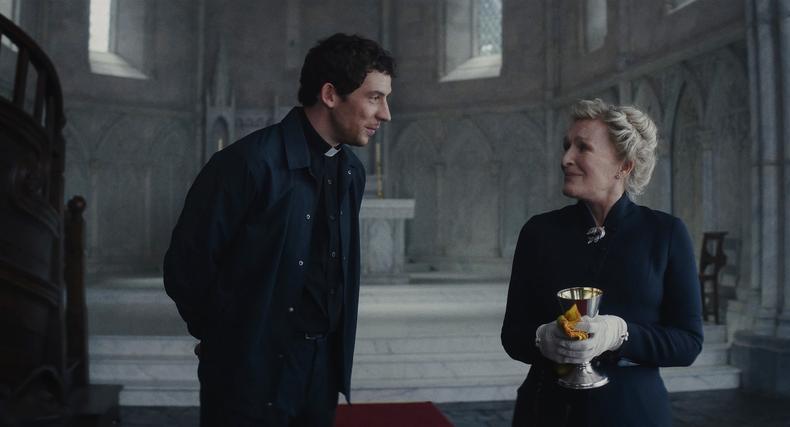
Josh plays Father Jud, which is the role that’s similar to Janelle Monáe in “Glass Onion” or Ana de Armas in “Knives Out.” It’s the role that has to immediately win the audience’s empathy. So I knew I needed somebody who was just going to pull you into the screen.
I saw “Challengers,” and I thought, Oh my God, who is this person? Then I saw “La Chimera,” and I realized, Oh, this is an actor with an incredible amount of range, who has that X factor that just locks you into their performance. Then I met him and he was so cool. I was just like, This is the guy. I just had no doubt. And in this movie, he gets to truly bring leading man energy to it. Glenn kept saying he made her think of Jimmy Stewart in this part, and I can see that connection. A good heart, but a truly compelling, complicated spirit on the screen.
Somebody from the cast we’ve talked to a few times that is always so eloquent about acting is Andrew Scott.
Andrew is just another one of those guys who is extraordinary, because I feel like he can do anything. He’s such a chameleon, and he’s so good at everything. So the reality is, we have this character who I imagined as a kind of burly, macho science-fiction writer, who is living in the woods and has gone full conspiracy theory—Joe Rogan manosphere, disconnected from society. I had no idea what Andrew Scott would be like in that part, but I thought, Whatever it is, I want to see it. So sometimes an actor is good enough that it’s not “Oh, this is their type of thing, so we’ll put them in this role.” It’s the exact opposite of “Wow, this doesn’t seem like them, so this is going to be fascinating to watch.”
I have seen you say in the past that you love to cast actors who can surprise you and do things in a way you didn’t envision. For an actor, what’s the difference between surprising a director in a good way versus a way that doesn’t work?
It comes down to the basics of: Does it feel true? Look, I’m not an actor, and I don’t want to give acting advice. But I feel like with anything, you don’t want to get in your head too much about being clever and thinking about my type versus the character type, and what have you.
For example, all of the stuff I just described about not expecting to see Andrew in that part, that was all my own headspace. From Andrew’s perspective, it wasn’t that at all. It was just reading the character, seeing how he responded to it, and then honestly playing those beats that were in the script. And because he’s Andrew Scott, that’s going to come out in a way that is going to surprise me. But he’s not making decisions in order to surprise me. He’s just doing what feels truthful to him and entertaining to him in the scene.
These scripts have always been so airtight, and you mentioned wanting to craft an impossible mystery for this one. In the writing phase, what’s the first thing you do when you’ve truly written yourself into a corner and aren’t sure how to proceed?
You walk away for a few minutes. [Laughs] The real answer is, there are a few different levels to that. The easiest level is, if it’s literally a logistics thing, like, “Oh my God, the cup is supposed to be on the table at this point so the poison can go in it, but it isn’t,” that’s just elbow grease; that’s just figuring it out and trying different options.
The tougher thing, which I think is maybe a more universal problem, is when a scene runs aground and is dramatically hitting a point where it doesn’t feel engaging. Or it doesn’t feel alive, or it’s not getting you where you need to get to. When that happens, I always zoom back. I always go back to my outline, or zoom way back and look at the scene in the context of what comes before and after it.
I zoom back to look at what the dramatic purpose of the scene is supposed to be. Is the way that I’m getting into the scene, or the perspective that scene is being told from, are those things playing to that dramatic purpose in the strongest way? Usually, that immediately shows you the answer. You’re like, “Oh, the purpose of this scene is to show this character gets the edge on this character. But I’m coming into the whole thing with all this bullshit about this other character who blah, blah, blah.” You can never go wrong with backing up—zooming back in Google Maps and looking at Google Earth for a second.
What about the filmmaking process still feels the most like a mystery to you?
It’s gonna sound like a cheat, but every part of it does. I think the day it doesn’t will be the day to hang it up and quit. Every single writing process is… well, a mystery is a fun way of putting what it is. [Laughs] It’s much more like having your head in a sack and wandering through the wilderness. Until it isn’t; until you find your way through it.
Every day on set, also, even after you’ve done all your planning. If you have your storyboards and your prep and you got the cast and you’re showing up, it’s your job to sit there when you call “action” and become an audience member, and have a genuine emotional reaction to what’s happening in front of you, and be truthful about that. And that requires you to not know, to not be thinking of all your plans and what you thought this was going to be. That requires you to open yourself up to the mystery of what this is and how it’s hitting you in that moment.
Then, obviously, in the edit, it’s analogous. It’s exactly the same thing. You’re sitting down, and it doesn’t matter what you structured in the script. It doesn’t matter what scenes you felt great about while you were shooting. All that matters is watching that cut, having your own emotional reaction to it, and then, as an audience member, parsing that honestly for yourself and shaping it to become what it needs to be.