
Being an influencer isn’t just taking photos on a nice-looking beach. There’s a lot of labor that goes on behind the scenes, and like with any labor, it’s important to get paid for it. A crucial part of this process is the influencer rate card, a document that enables transparency and accountability when an influencer does a job for hire.
JUMP TO
An influencer rate card is a document that outlines the types of content and services a creator offers—along with the prices associated with each. It’s typically shared with brands, agencies, or potential partners during outreach, negotiations, or inbound inquiries. Want to become a TikTok influencer? You need to understand rate cards.
At its simplest, a rate card answers three questions for brands:
- What do you offer?
- How much does it cost?
- What does the brand get in return?
A standard influencer rate card often includes:
- Platform(s) you create content on (Instagram, TikTok, YouTube, etc.)
- Content formats offered (posts, Stories, Reels, videos, UGC, etc.)
- Base rates for each format
- Optional add-ons (usage rights, whitelisting, exclusivity, rush delivery)
- Basic audience or performance context
Importantly, a rate card is not a rigid price list carved in stone. Think of it as a starting framework—a way to anchor negotiations and signal professionalism. Brands still expect discussion, but a rate card ensures those discussions begin from a place of clarity rather than uncertainty.

Prostock-studio/Shutterstock
For creators, rate cards serve several strategic purposes.
First, they save time. Instead of repeatedly explaining your offerings and pricing, you can send one document that answers common questions upfront. This is especially helpful as inbound requests increase.
Second, they reinforce your value. A well-designed rate card positions you as a professional creative partner rather than a hobbyist posting casually online. It reframes the relationship from “asking for freebies” to “purchasing a service.”
Third, rate cards help creators price more consistently. Without one, many influencers undercharge, overcharge, or quote different rates depending on the brand. A rate card creates internal clarity—even if you adjust pricing externally.
Finally, and perhaps most importantly, rate cards are useful negotiation tools. By presenting structured pricing with optional add-ons, you give brands flexibility while protecting your baseline value. They’re crucial to becoming an IG influencer, YouTube creator, and more.
Creating a rate card is less about graphic design and more about pricing strategy. The most important work happens before you ever open a design tool. Below are the key steps and factors involved in determining your rates.
1. Identify what you’re actually selling.
Influencers often think they’re selling “posts,” but brands are usually paying for a combination of things:
- Access to your audience
- Creative production (concept, filming, editing, captions)
- Distribution on a specific platform
- Trust and credibility you’ve built over time
Before pricing anything, list out every deliverable you might offer. Common examples include:
- Instagram feed posts
- Instagram Stories (single frame or bundles)
- Reels or short-form videos
- TikTok videos
- YouTube integrations
- UGC-style videos (not posted to your own feed)
- Cross-posting across platforms
Each of these has different time commitments, creative demands, and value to brands. Your rate card should reflect that distinction rather than lumping everything together.
2. Factor in platform differences.
Not all platforms are valued equally by brands, and your rates should reflect where the demand and performance are strongest.
For example:
- Instagram often prioritizes visual polish, brand safety, and lifestyle alignment.
- TikTok values authenticity, trend participation, and short-form storytelling.
- YouTube integrations typically command higher rates due to longevity and depth.
- UGC-only content (where brands post your content themselves) is priced differently than sponsored posts on your own account.
As influencer marketing expert Jenny Song Schmidt explained, “Instagram has been the number one platform for influencer marketers for so long, but since 2022 it’s experienced hardships in terms of ROI…. Marketers have been proactively testing other channels, going back to the roots, to YouTube. They’re also testing platforms that go more into performance than TikTok.”
Creators frequently charge more for platforms where:
- Content takes longer to produce
- Videos require editing
- Content lives longer or is reused by brands
Your rate card can separate pricing by platform or clearly indicate which platforms are included in bundled offers.
3. Consider follower count.
Follower count is often the first metric brands look at, and many creators base their rates on it. While it’s a useful reference point, it shouldn’t be the only factor.
That said, general industry benchmarks do exist. A common (very rough) starting point for sponsored content is:
-
$100 per 10,000 followers for a single static post
However, this varies widely depending on:
- Engagement rate
- Niche (finance, tech, and B2B often command higher rates)
- Content format (video typically costs more than static)
- Creator experience and track record
Nano- and micro-influencers with strong engagement can often justify higher rates than larger accounts with passive audiences.
“The influencers that get the deals are generally the ones who have been around for a while, or who cater to a very niche topic and have a good community,” Schmidt noted.
Your rate card doesn’t need to explain this in detail, but your pricing should reflect it.
4. Account for engagement and performance.
Brands increasingly care about results, not just reach. If your content consistently drives:
- High engagement
- Strong click-through rates
- Conversions or sales
…you can (and should) price accordingly.
While you don’t need to include detailed analytics on your rate card, you should factor performance into your pricing internally. A creator with a smaller but highly responsive audience often delivers more value than a larger, disengaged one.
If you offer performance-based bonuses or affiliate components, your rate card can note that these are available upon request.
5. Price in your time and labor.
Many creators underprice because they only think about posting, not production. When setting rates, consider:
- Time spent planning concepts
- Filming and reshoots
- Editing and revisions
- Caption writing and approvals
- Communication with brands
- Posting and follow-ups
A Reel or TikTok that takes 30 seconds to watch may take several hours to produce. Your rate card should reflect the total labor involved, not just the final output.
6. Add line items for usage, exclusivity, and whitelisting.
This is one of the most important (and most overlooked!) parts of a rate card.
Brands often want to:
- Repost your content
- Use it in ads
- Run it as paid social
- Prevent you from working with competitors
These are additional rights, not freebies.
Common add-ons include:
- Usage rights (30 days, 90 days, perpetual)
- Paid usage/whitelisting (brand runs ads from your handle)
- Exclusivity (no competing brands for a set period)
- Rush fees
- Raw footage delivery
Your rate card doesn’t need exact legal language, but it should make clear that base rates cover organic posting only—and that additional rights cost extra.
Influencer rate cards vary widely in format, but most fall into a few common styles.
Simple rate sheets are clean, one-page documents listing platforms, deliverables, and prices. They’re common among micro-influencers and creators early in monetization.
Rate card and media kit hybrids combine pricing with audience demographics, engagement stats, and past brand logos; they’re often used by mid-size creators working with agencies.
UGC-focused rate cards emphasize content creation rather than audience size, listing video deliverables, hooks, raw footage, and usage terms, making them popular with creators working in paid social.
Premium creator rate cards include bundles, long-term partnership pricing, and detailed add-ons, used by established influencers with repeat brand relationships.
While formats differ, the strongest rate cards share two traits: clarity and confidence. Check out the following rate card (from Influencer-Hero).
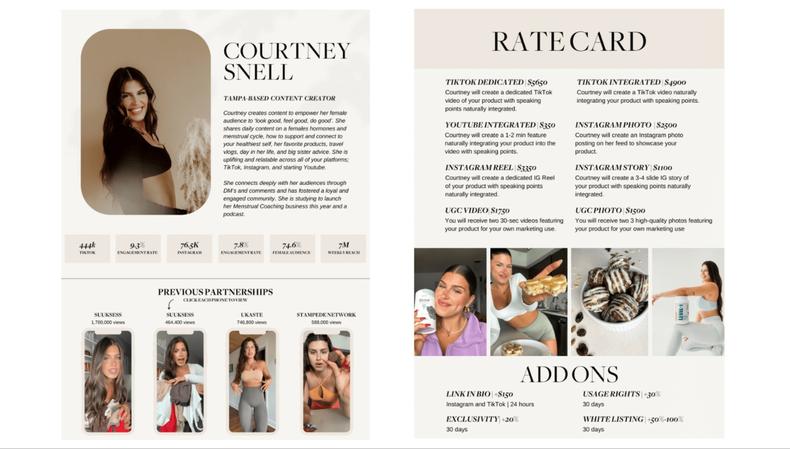
Below is a flexible template you can adapt to your niche, platform, and experience level.
[Your Name / Handle]
Influencer & Content Creator
Platforms:
Instagram | TikTok | YouTube (list only what applies)
Sponsored Content Rates
- Feed post: $___
- Reel: $___
- Stories (3–5 frames): $___
TikTok
-
Video: $___
YouTube
-
Integrated mention: $___
UGC (Not Posted to My Feed)
- Short-form video (15–30s): $___
- Raw footage add-on: $___
Add-Ons & Usage
- Usage rights (30 days): $___
- Paid usage/whitelisting: $___
- Exclusivity (per month): $___
- Rush delivery: $___
What’s Included
- Creative concept and production
- One round of revisions
- Organic posting (where applicable)
- FTC-compliant disclosure
Notes
- Rates listed are starting points and may vary based on scope
- Custom packages available for long-term partnerships
Contact:
Email | Instagram | Website