From Priyanka Chopra to Ranveer Singh, Bollywood has launched countless actors who dared to dream big—but getting your foot in the door requires more than just talent and ambition. Bollywood cinema is almost entirely star-driven. Belonging to a “film family” or having a “Bollywood godfather” who is familiar with the industry may help you to get a foot in the door, but that’s just about it. The audience is the final arbiter, and it does not distinguish between the kids of stars and an outsider.
So, how do you become an actor in Bollywood? Read on for a comprehensive guide to becoming the next big thing in Bollywood—everything from finding auditions to locating the best place to live in Mumbai.
JUMP TO
- What should I know before beginning my acting career in Bollywood?
- How do I become a Bollywood actor?
- What tools do I need to become a Bollywood actor?
- What training do I need to become a Bollywood star?
- Should I also pursue modeling, theater, or television acting?
- What are some key Bollywood terms I should know?
- Where should I live in Mumbai?
- How do I find Bollywood auditions?
- How do I make a living as an actor?
- Do I need an agent to make it in Bollywood?
“Bollywood” is not the same thing as Indian cinema. India churns out close to 2,000 feature films every year in more than 20 different languages—yet in recent years, only about 300–400 Hindi films are released annually by the dream merchants of Mumbai. The bulk of the output is attributed to films made in Tamil, Telugu, Kannada, and a host of other languages spoken across India.
Yet Bollywood is still regarded as the face of Indian cinema. This is mainly because Hindi is the “link language” of the country. A Hindi film commands an overarching pan-India reach no other language can match. Thus, Amitabh Bachchan becomes a national icon, whereas a far more accomplished actor in, say, Telugu or Kannada is less known outside their region. Today, Chopra and Shah Rukh Khan enjoy a fan following across the globe, whereas few would have even heard of homegrown superstars like Rajkiran or Karthi outside of Tamil Nadu. It’s a small wonder Bollywood has witnessed a continuous influx of talent and remains the filmmaking hub of India.
Another notable point is that Bollywood still abides by a rigid, time-tested formula that goes well beyond its extravagant sets, lavish song-and-dance sequences, and happily-ever-after endings: a deep-rooted adherence to mythology—specifically, the “Ramayana” epic. It is the classic “good versus evil” template within which the hero is necessarily an embodiment of self-righteousness and invincibility (like Lord Rama), the heroine plays the self-sacrificing and virtuous damsel in distress (like Sita), and the villain represents all things vile and wicked (like the demon king Ravana). The comedian takes on the persona of the monkey god Hanuman, and the hero’s best friend is invariably Lord Rama’s brother, Lakshmana, in what, more often than not, boils down to morality plays.
Things are, of course, changing. Offbeat films—such as socials, biographicals, and LGBTQ+ films—have changed the complexion of Bollywood cinema to an extent. But there’s nothing to beat “the formula,” especially with mainstream family dramas, crime thrillers, romantic potboilers, and even horror films. The moment the public appreciates and looks up to you as a demigod in a certain role, you become a star. On the other hand, there is the constant danger of being typecast. You are stuck with an image from your very first hit and expected to repeat yourself ad nauseum. Even middling hits have turned ordinary mortals into matinee idols. The challenge lies in sustaining the image over time. And that is what makes Bollywood such an exciting place.
To become a Bollywood actor, you’ll need to master the fundamentals: Do your research, work on your career timeline, polish your Hindi with a Bollywood diction coach, and—as always—network, network, network!
1. Do your research.
Don’t be fooled by the talk that “there’s work for everyone” in Bollywood. You need to go out there, reach out, create an identity for yourself, and, only then, expect to get work. Put pen to paper and do an honest self-assessment of how exactly you fit in as a Hindi film actor. List your strengths and weaknesses. What challenges do you face? What are the opportunities you can exploit? Try to be dispassionate. You may feel that you lack the looks of a hero, but with a natural sense of humor or comic timing, you could make an ace comedian like Mehmood or Johny Lever. But then consider, are roles written for comedians any longer? If so, where are they being written? Stay updated. Talk to friends (especially those in the industry), watch new releases, and read up on current trends.
2. Plan out your timeline.
There is no point stepping into Bollywood and hanging around indefinitely waiting for your big break. This is a mistake most star aspirants make. True, many are privileged enough to have supportive families, a generous “uncle-ji,” or even parallel incomes from investments or rented property. But at some point, you need to cut your losses. Be realistic about the time you allow yourself to make your mark as an actor. Will it be one year, two years, or five years? It all depends upon your resources. How much are you willing to invest in this career move? Once you’ve decided on your budget, stick to it. Remember, Mumbai is an expensive city. For an actor, things become doubly so because appearances matter: the car you drive, the neighborhood you stay in, the gym you go to, the clubs and restaurants you frequent, and whom you are seen with. You have to be perceived as a celebrity before you may become one.
3. Get your language skills where they should be.
Get your Hindi right. The language in Bollywood films is neither the colloquial “khari boli” spoken on the streets nor the chaste, bookish Hindi of academia. It is a peculiar amalgam of several Hindi dialects with a strong Urdu intonation. So, wherever you hail from, get hold of a good Bollywood diction coach and brush up your language skills. There are countless such professionals floating around the city who do a good job at giving you a neutral Hindi accent. Their services are often affordable, and acting classes will not provide you with the one-on-one attention you require. Even native Hindi speakers must go through this orientation process.
4. Learn to network.
Want to catch the eye of a hotshot director? Want to meet with the movers and shakers in town? Want someone to slip in a kind word about you during the casting of a film? Want to be called for auditions? You cannot afford to stay invisible. Move out, circulate, make friends, and strike conversations. Be proactive. For if you are not seen or heard, you simply cease to exist. Grab—with both hands—whatever invitation you get, be it to a film launch (“mahurat”), birthday bash, trial screening, ramp show, seminar, workshop, film premiere, or jubilee celebration. You can never say who you’ll meet, where and when, and how it could be the turning point of your career.
The other platforms for serious networking are:
- Film festivals
- Amateur theater (and rehearsals)
- Club and gym memberships
- Popular hangouts, such as restaurants and cafés
- Social media platforms like WhatsApp groups, Facebook, Twitter, or Instagram
5. Use Backstage to find opportunities.
As an international actor looking to break into Bollywood, leverage Backstage’s casting notices to find opportunities in Mumbai and India. Filter by location to discover Bollywood casting calls, and create a strong actor profile to showcase your work to casting directors searching for talent.
6. Keep persevering.
Don’t lose heart if someone you exchanged numbers with over dinner refuses to take your call the next morning. This happens all the time. The big shot who gets sloshed (at your expense) in a bar may never remember you again. Bollywood denizens are notorious for selective amnesia. It is part of the culture, and there’s no point taking offense. Still, there is no shame in keeping in touch. In fact, your perseverance will only establish how serious you are about pursuing your profession. Learn to develop a thick skin like everybody else and keep persisting. You have everything to gain and nothing to lose.
To become a Bollywood actor, you’ll need to start with a CINTAA membership card, a headshot, a résumé, a show reel, and, perhaps, a screen name.
Membership card: No actor can face the camera in a Bollywood studio unless they are a member of the Cine and TV Artistes’ Association, or CINTAA. This is a trade union outfit, much like the Screen Actors Guild in Hollywood, meant ostensibly to safeguard the interests of Hindi film actors. In reality, though, it functions (under political patronage) as a gatekeeper to stop so-called “intruders” from entering Bollywood.
You need to obtain a work permit for a fee of Rs. 10,000, valid for one year. After completing two consecutive years of work permits (paying Rs. 10,000 for each year), you become eligible for regular membership in the third year, which requires an additional entrance fee of Rs. 10,000, a one-time membership welfare fund of Rs. 500, and an annual subscription of Rs. 1,200. There is also provision for being a lifetime member once you complete seven consecutive years as a regular member.
Headshot: The importance of what is known as portfolio pictures in Bollywood cannot be overemphasized. It is with these that a fresher makes the first impression on a filmmaker. Your entry pass to a production house rests entirely on these introductory photographs you present. You should always rely on the judgment and skills of a professional. There are hundreds of full-time photographers in Bollywood specializing in this kind of work who charge by their reputation and track record. Study their work (it’ll be on their website) and select someone affordable who appeals to your sensibilities. Once a decision is made and terms settled, do not interfere. Trust your photographer completely. The biggest mistake people make is to instruct a photographer on how to make them look good (or younger). Professionals know best how to show you off to your advantage. That is why you did not hire an ordinary press or celebrity photographer in the first place.
Show reel or demo reel: A show reel forms part of the portfolio every actor must put together. Keep it short and sweet, around two to three minutes. Selectively pick out recent work that you are proud of. Focus on what best showcases your acting skills, rather than how prestigious those assignments were. Be your own judge. When in doubt, use a friend (better still, a senior actor) as a sounding board. The idea is to be as objective as possible in your selection. Also refrain from gimmicks in the show reel, such as fancy transition effects, montages, echoes, or background music. These can be distracting in an otherwise good show reel.
Résumé: Here, again, be brief. Bollywood directors are known to be allergic to the written word (especially in English) unless it has something to do with a film script. So, stick to the basics in your résumé: name, date of birth, mother tongue, contact number, passport details, education, training (if any), and special skills. Keep it to a single A4 sheet of paper. Attach an “annexure” with a summary of acting jobs you have done in chronological order, beginning with the latest. Don’t forget to include amateur plays, even school- and college-level drama since actors with a theater background are always respected. List them all in bullet form so that anybody reading the résumé can size you up at a glance. After all, a résumé serves as a ready reckoner, an add-on to the headshot and show reel that constitute your portfolio.
Screen name: This is optional. But there was a time when every other Hindi actor took on a screen name, almost by default. Muhammad Yusuf Khan became Dilip Kumar. Mumtaz Jehan Dehlavi became Madhubala. Aabhas Ganguly became Kishore Kumar. Badruddin Jamaluddin Kazi became Johnny Walker, and so on. Today, this does not happen so widely. Still, we have a Rajiv Hari Om Bhatia who goes around as Akshay Kumar, and there is also Inquilab Srivastava, better known as Amitabh Bachchan. Whatever your reasons for choosing to use a screen name (numerology, superstition, etc.), it does not guarantee success. So, you decide.
 How to Create Your Acting Showreel
 Bollywood’s most successful actors have almost all been self-taught. Even today, no top star has been through any formal training. Many would therefore discourage you from joining an acting school. At the same time, there can be no denying that an acting school is the first major stepping stone to Bollywood for any newcomer. Where else would you be able to learn not only how to emote in front of the camera, but other tricks of the trade—such as image grooming, horse riding, Bollywood dance, stunts, and fencing—all in one place? This explains the mushrooming of training schools, with some even promising placement services. The most reputed and popular among them are:
Film and Television Institute of India (FTII): Set up in 1960 in Pune, this government-run institution offers a two-year post-graduate diploma in acting (among a host of other courses, such as direction, cinematography, sound engineering, and animation). FTII was granted university status in 2025. Admission is through a competitive written examination (the Joint Entrance Test, or JET) and interview.
National School of Drama (NSD): Generally regarded as the “cradle of Indian actors,” this, too, is a government-run institution. Established in New Delhi in 1959, NSD conducts a three-year course in the dramatic arts. You need to have acted in at least six plays and be able to furnish three recommendations from theater experts before you can even apply. The minimum age is 18 years and the maximum is 30 years (with a five-year age relaxation for SC/ST candidates). The selection process includes a preliminary audition followed by a five-day final workshop at NSD.
Whistling Woods International (WWI): Set up by filmmaker Subhash Ghai in Mumbai, this CILECT-affiliated film school has offered degree and diploma courses in acting since 2006. Affiliated with the Tata Institute of Social Sciences (TISS), WWI offers a BFA in acting (three years), as well as various other film-related programs. Facilities are good, fees are steep, and admission requires passing the WWI Entrance Exam (MECAT), auditions, and interviews.
Actor Prepares: Set up by film star Anupam Kher in 2005, this Mumbai-based acting school is immensely popular as it conducts a host of short-term courses suited to your budget: a three-month full-time diploma course, one-month part-time certificate course, acting workshops, and more. It’s a good place to get your feet wet. Alumni include Deepika Padukone, Hrithik Roshan, Kiara Advani, and Varun Dhawan.
Kishore Namit Kapoor Acting Institute: The founder is an FTII alumnus, regarded as the best acting teacher around. Since 1983, his acting institute has offered various certificate courses as well as year-round refresher courses. His ex-students read like the who’s who of Bollywood today, including Hrithik Roshan, Kareena Kapoor, Priyanka Chopra, Ranveer Singh, and Vicky Kaushal.
There are several other popular acting institutes, most of them privately run in Mumbai itself, including Roshan Taneja School of Acting, Vidur Acting Institute, and Barry John Acting Studio. But the most reputed and prestigious training institute is without a doubt the state-owned FTII. However, for every Naseeruddin Shah or Shabana Azmi who has gone on to make a name, there are scores of ex-FTII actors who do not reach anywhere and fade away in anonymity. On the other hand, untrained actors seem to get a better deal (as mentioned earlier) in Bollywood. Ultimately, it is entirely up to you whether or not to go for training.
Credit: amnat30/Shutterstock
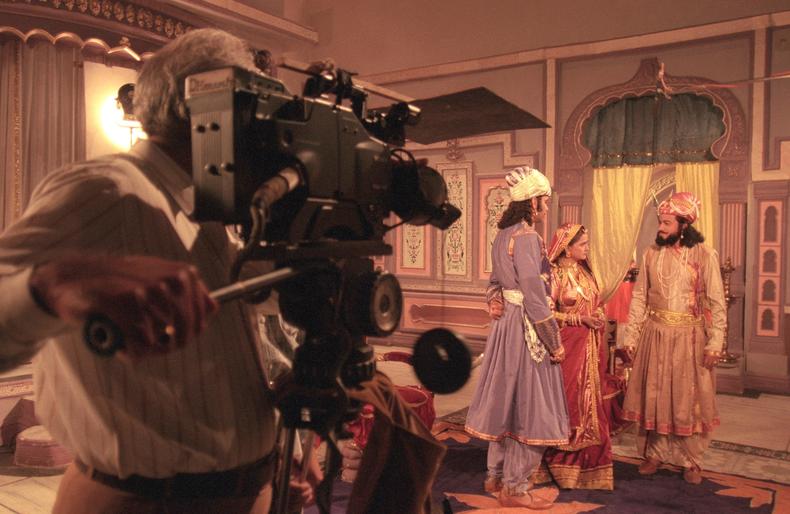
A background in modeling, even more than acting school, promises an enduring foundation to an acting career in India. For example, appearances in press ads and ramp shows have served as excellent launch pads. Theater is, of course, the time-honored route actors have taken before finding their bearings, and the same goes for television these days. Each medium presents its challenges and makes particular demands but in the end guarantees visibility—not to mention good money. Make the most of the situation until you get your break in films.
Modeling: From Kabir Bedi to Zeenat Aman, John Abraham to Arjun Rampal, countless Bollywood stars have got their start by plugging textile brands, beauty products, cars, electronic gizmos, and the like. The trend continues, except today, models are usually called brand ambassadors. They typically graduate from press ads and billboards to ramp shows, do a few ad films in between, and somewhere along the way, take the leap to films. This is considered the natural course of progression for a Bollywood actor. The single big advantage modeling affords is that it teaches you how to project yourself to your best advantage when facing a camera.
Theater: Stage experience can matter a great deal. Having a theater background is a huge plus because you are instantly regarded as more proficient in the craft than any other greenhorn—not to mention, it means less work for the director. Moreover, emoting for the camera becomes less of a challenge for you. Actors with exposure in theater have never failed in Bollywood, right from Balraj Sahni to Amjad Khan to Om Puri, and today, Naseeruddin Shah and Shah Rukh Khan. The trouble is there are not many of them around. The few who move to cinema are thus highly respected. Many directors, in fact, are known to habitually frequent every new play in town in the hope of discovering fresh talent. Case in point: Ramesh Sippy discovered Amjad Khan and cast him in “Sholay” (1975) after watching him perform in a local Hindi play.
Television: India has close to 900 private television channels, each with its fair share of serialized dramatic content and film-based entertainment. So, a fresher can get work in television without much of a problem. It allows you to be among peers, develop contacts, and get noticed. Don’t be under the mistaken impression that once you’re a TV actor you will always be a TV actor. In fact, there is not much that separates the small screen from the big. The working conditions are the same: Studios and other infrastructure are common, directors, makeup teams, hairdressers, cameramen, and other technical crew are shared, and all artists including dancers and musicians constantly move between the two mediums. Even the pay structure per six-hour shift is the same for TV and film.
It is therefore not uncommon for actors working in television to move to cinema and after a while return to doing a sitcom until another opportunity opens up in film. Interaction between the two mediums is so fluid that every Bollywood trade union is made up of members from both streams. If there is any difference between the two, it is in perception. Working in film is considered more prestigious, a step-up in comparison to a TV series, purely because of the reach and permanence of cinema.
The language spoken at all levels in Bollywood is Hindi, unless there’s mention of something technical, at which point English comes into play. Even then, these would be words as commonplace as “Lights, camera, action!” Here is some filmy argot that has gained currency over time:
- Item song: A completely extraneous musical intrusion featuring a ritzy screen diva that does nothing to move the plot forward. It is included purely to raise the sales pitch of music videos and provide some advance publicity for the film, as well. The dancer, also referred to as an “item girl” in common parlance, is invariably not even a character in the film.
- Masala movie: Derived from the Hindi word for a blend of spices, such a film is known to contain the standard ingredients of run-of-the-mill Bollywood potboilers: drama, romance, fights, song and dance, comedy, suspense, and stunts. A masala movie stands a better chance at the box office than an offbeat or so-called “realistic” film.
- Struggler: A derisive reference to starry-eyed film hopefuls who haven’t quite made it and continue to struggle with bit jobs in the interim to make ends meet. A struggler is identified by a fierce sense of optimism and ability to stay the course in the face of extreme adversity.
- Thumka: A term indicating a hip movement that Bollywood dancers are known for. Every heroine is expected to know how to execute this sidewise hip jerk.
Where and how you live in Mumbai depends on what you can afford as an early-career actor. Mumbai is one of the most expensive cities in the world. Unless you have a friend or relative who can host you for an indefinite period, be prepared to budget between Rs. 25,000 and Rs. 80,000+ as monthly rent for a one-bedroom apartment in a fairly decent neighborhood in the suburbs—if you’re lucky. Mumbai landlords are notoriously prejudiced against people (especially singles) without a steady income. Most Bollywood hopefuls therefore end up buying off a place or finding roommates (sometimes up to eight people to a room). You could count yourself among a privileged few if you were able to share an apartment with the landlord as a “paying guest” on a nominal rent.
The neighborhood you choose to stay in is a no-brainer. Almost all Bollywood studios (including Film City and assorted recording studios) are clustered around Andheri and Goregaon in the northwest suburbs. All newcomers gravitate toward these locations to save travel time and costs. But then, you will have to decide your address not only by what you can afford, but also by the impression you need to create. Staying in a Goregaon working-class colony is not the same as holding an apartment in Andheri. Perceptions matter in Bollywood—particularly when you want to be seen as potential star material. Your options are:
- Lokhandwala Complex: Conceived as a mini–Beverly Hills of Bollywood, this is home to some of the most successful actors, playback singers, choreographers, and directors. If you enjoy bumping into them while shopping, at the gym, or in the club, then this is your place. Rents are steep, but landlords are accustomed to having film folk as tenants here.
- Yari Road, Versova: Also in Andheri, this is your next best option after Lokhandwala Complex. Equally swanky, the neighborhood has outgrown its reputation as an area exclusively inhabited by TV actors. Rents are lower than Lokhandwala, but you will have to spend more in travel time to the studios.
- Bangur Nagar: Located in Goregaon, this is where most out-of-towners settle initially. The area has a fair share of film celebrities and even if you do not hold a prestigious address, you can draw comfort from being among your peers. The rent is comparatively affordable here and you would be in closer proximity to the studios.
- Oshiwara: An extension of Lokhandwala Complex, this is where women often begin their film careers. Many of them work as part-time dancers, models, and singers in both film and television. Living conditions are a far cry from what Lokhandwala has to offer, but over time, a sisterhood of artists has developed in this locality.
- Gokuldham: Although located close to Film City in Goregaon, this is not an address a star aspirant would ordinarily settle for—and yet this area is buzzing with acting hopefuls, most of them working as junior artists (read: extras) and character actors, as well as stuntmen and dancers. Rents are very affordable here.
- Bandra: One of the earliest settlements for film folk in Mumbai. This is where the crème de la crème of Bollywood resides (or wants to). It is located closer to the city center but has only one film production center, Mehboob Studios, in its ambit. Having an address in Bandra means you have arrived. But as a fresher, moving here is not recommended, because in a status-conscious Indian society, you will be taken to be a pretender.
- Mira Road: An upcoming township located about an hour’s drive from the Lokhandwala-Goregaon belt. It is the current magnet for newcomers as living conditions are good and rents are affordable. A couple of television production houses have set up shop here of late.
The simple answer is that you’ll find Bollywood auditions through word of mouth—but the casting landscape has evolved significantly. Leading casting directors like Mukesh Chhabra, who discovered Sushant Singh Rajput and Rajkummar Rao, and Shanoo Sharma at Yash Raj Films, who introduced Ranveer Singh to Bollywood, play crucial roles in shaping careers.
Bollywood does not have a tradition of engaging talent scouts or professional agents to attract job aspirants for movie auditions. Everything is arbitrary. Often, recommendations work for assigning roles. There are trade journals that you can read to keep abreast of films to be launched, big names signed, or films registered by a production banner. Take your cue from there. But beware of advertisements inviting fresh faces for a production “to be launched soon.” You may be called for an audition in some makeshift studio or hotel room and asked to pay an exorbitant sum, and that would be the last you’d hear of the scamster.
Remember, no reputed director or production house advertises for auditions. The main leads have almost always already been signed before a film is even announced. Next in line is the supporting cast: family members of the hero and/or heroine, the villain, best friend, comedian, etc. This is where you stand a chance. Directors usually have a trusted team around them with whom they have already worked and whose opinion or recommendation they value. This team includes the script writer, casting director (if any), and producer or financier. They will be present at auditions, and it is with these people you need to make your strongest impression.
A common Bollywood practice is to have a drop box at the gate or reception area of every production house. This is where acting hopefuls drop their portfolios, comprising the headshot, CV, and show reel. The box is emptied at regular intervals, and details from each portfolio are entered into a computer. This serves as a critical resource for a filmmaker when casting is done. Make sure you are in that box. For, you can never say when you get the audition call, which could change your life.
Modern actors also leverage social media to find casting calls. Follow casting directors like Mukesh Chhabra Casting Company and YRF Casting, and join Facebook groups like Audition in Mumbai and Auditions India, in which casting directors frequently post opportunities. Many casting directors now use online platforms to discover new talent, making it easier than ever to get noticed—but also requiring actors to be more proactive in their search.
What many out-of-work actors do is plunge headlong into modeling. For this, you would have to pay a fee to register with modeling agencies and take up occasional assignments for a photo shoot or ramp show on an income-sharing basis. Working with ad agencies is also an option. It helps to be in circulation. But what you earn may just about cover your out-of-pocket expenses, unless you make a name for yourself as a hotshot model.
The other option is to join a professional theater group where the payments are better and more consistent. Rehearsals are usually held in the evenings and on holidays. The only catch here is that not many Hindi (or English) plays are staged in Mumbai. In contrast, Gujarati-language plays command a massive theater audience, and at any time, at least a dozen Gujarati plays run to packed houses across the city. So, this becomes a crowded area for a film aspirant in Hindi.
There is yet another option, but this is open to those who already have family connections with the film industry: It is to work as an AD, or assistant director, doing odd jobs on the sets, just to figure things out and be seen around. Others not related to anybody in the unit are expected to volunteer their services and are rewarded with, maybe, a free lunch.
You do not need an agent to succeed in Bollywood, but it can be helpful, according to the Barry John Acting Studio.
For more about getting your acting career started, check out the Backstage Guides!