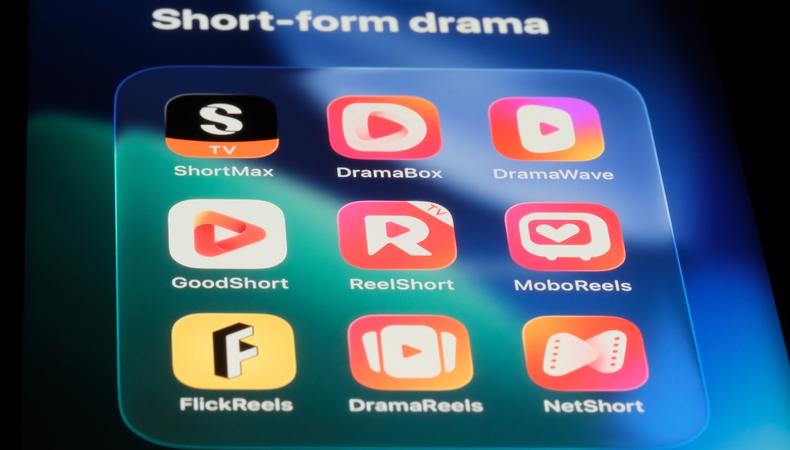
If you think soap operas are dead, think again—they’ve just gone vertical. These fictional series echo the same tropes of classic soaps but are built for the smartphone screen. With revenue projections pointing toward $26 billion globally by 2030, it’s no wonder major studios like Fox, Lionsgate, Paramount, and TikTok have all placed bets on the format. For actors, creators, and crew, the platforms behind it are creating a steadier flow of paid work than traditional TV has offered in years. Here’s a breakdown of the biggest players right now.
1. ReelShort
Owned by Crazy Maple Studio, ReelShort is the dominant U.S. platform by most metrics, including roughly $300 million in revenue in 2024 and a user base that crossed 50 million by mid-2025. Its growth, according to Deadline, is clear, with a jump in app store revenue from $36 million in 2023 to $214 million in 2024. ReelShort CEO Joey Jia told TheWrap the goal for 2025 was a new show every day.
Those new shows continue to lean hard into romance and revenge, with stories built around premises like the secret billionaire, the arranged marriage, or the bodyguard who falls for their client. The breakout title “The Double Life of My Billionaire Husband” has passed 500 million views on the platform.
Like most vertical series platforms, ReelShort operates on a freemium model. The platform gets viewers to watch a handful of episodes for free with juicy cliff-hangers, then prompts payment via coin bundles or a subscription to unlock the rest of a series.
For actors, ReelShort casting has become one of the most reliable sources of consistent paid work in Los Angeles. Lead roles pay upward of $1,000 a day, while supporting characters start around $300. Productions move fast—a full series can wrap in under two weeks. The platform also maintains an in-house writing staff, making it an entry point for writers straight out of film school.
2. DramaBox
Owned by Singapore company Dianzhong Technology, DramaBox put up numbers in 2024 that turned heads at Disney. According to a Deadline report, DramaBox posted 2,550% year-on-year app store revenue growth, going from $8 million in 2023 to $217 million across 84 markets in 2024. Since then, Disney has placed DramaBox in its selective accelerator program. The platform also announced plans to expand into family content and choose-your-own-adventure formats. Actors seeking advice and opportunities in the vertical realm should anticipate that new genres will open more doors.
3. GoodShort
Vertical platform GoodShort claimed the No. 3 vertical app spot in the U.S. in 2025, bringing in roughly $220 million in global revenue, according to Our Culture. Top titles include the time-traveling billionaire romance “Victory Is in Hand” and the self-explanatory “My Gangster Baby Daddy Pampers Me to Paradise.”
Vancouver-based casting director Monika Dalman, who has worked with GoodShort on local productions and vertical series casting calls, told the Hollywood Reporter, “There’s something about these stories that really draw people in, and especially at times of chaos and confusion.”
4. ShortMax
ShortMax plays all the major hits, from werewolf dramas to billionaire romances and revenge sagas. The platform posted 3,888% year-on-year revenue growth from 2023 to 2024, the fastest rate of any major platform. ShortMax is also one of the content suppliers for TikTok Minis, a section within the app featuring vertical microdramas, which extends its distribution well beyond its own user base. If it continues to supply content for TikTok’s vertical app PineDrama, ShortMax will be one to watch for anyone looking to break into more vertical work.
5. My Drama
My Drama works differently from most platforms on this list. Owned by Ukrainian company Holywater, My Drama doesn’t rely on volume like its competitors. Instead, it launches just a few series per month and runs an integrated IP loop where stories originate in its e-novel app My Passion, get adapted into video, and can return as sequels.
The business results back the approach. Holywater closed a $22 million Series A funding round, making it the largest confirmed investment in the microdrama sector outside Asia. Fox Entertainment holds an equity stake with a commitment to 200 vertical titles, and in January 2026, Fox and Dhar Mann Studios added a separate deal for 40 more titles exclusively on the platform. This means Hollywood-caliber productions are being built for the vertical format with the implicit intention of appealing to mainstream U.S. audiences: “The Diamond Rose” hit 20 million views in its first 24 hours on the app, and “Playback” will be the first musical ever produced for vertical video.
6. GammaTime
GammaTime launched in October 2025 with a stacked team, including founder-CEO Bill Block and CCO Alex Montalvo. The platform also recently poached ReelShort producer Sandra Yee Ling to build out its production pipeline.
Anthony E. Zuiker (“CSI: Crime Scene Investigation”) became the first major Hollywood showrunner to announce projects written specifically for a microdrama platform. His two GammaTime originals, “The Temptress” and “Lust Cop,” sit alongside true-crime series based on Richard Ramirez and Karen Read and a slate that launched with more than 20 titles, with dozens more in the pipeline for 2026.
Zuiker told the Hollywood Reporter that the allure of the format for creatives is in seeing their ideas actually get made: “Every time I call Bill Block and say, ‘I’ve got an idea,’ the answer is ‘Yes.’ ” Series go from greenlit to release in six to eight weeks. For anyone who has watched a TV pitch sit in development for two years, that turnaround is a different industry entirely—and for Hollywood veterans like Zuiker, it’s what sold him on the format.
7. PineDrama
TikTok quietly released PineDrama in the U.S. and Brazil in January 2026 with no official launch announcement. The app mirrors TikTok’s feed with one-minute episodes, personalized recommendations, and real-time viewer reactions, but it swaps creator content for serialized vertical fiction.
The free and ad-free model is deliberate. Streaming consultant Hernan Lopez told Business Insider it’s “a sign that vertical video is evolving,” predicting more company announcements throughout 2026. Subscriptions or paid unlocks are expected eventually, but TikTok is running PineDrama as a test of whether its recommendation engine can make the jump into scripted fiction.
Content suppliers include Dreame, ShortMax, and Stardust TV, which were already feeding TikTok Minis back in 2025. TikTok kept PineDrama out of Asian markets, where its parent company ByteDance already has competing apps. Instead, PineDrama appears to be a Western-market play built on a playbook already proven overseas.
PineDrama may be a platform to watch rather than actively participate in right now. Its next test is whether it can develop or acquire original content that connects with Western audiences as effectively as its competitors have. With 183 million U.S. monthly TikTok users just one tap away, that production pipeline is worth paying attention to.