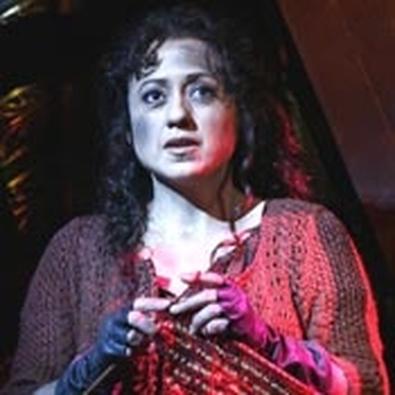
If you somehow missed Les Misérables during its original 16-year Broadway run or its recent revival, you need look no further than Jill Santoriello's syrupy musical version of Charles Dickens' A Tale of Two Cities. In addition to sharing a backdrop of French political turmoil — Tale is set during the French Revolution in the late 18th century, while Les Miz takes place a few decades later amid another citizen uprising — both suffer from a surfeit of sentiment. While the creators of Les Miz balanced the saccharine with dynamic staging and emotional honesty, Tale drowns the audience in an ocean of schmaltz. In addition, Santoriello, who wrote the book as well as the songs, hasn't just taken a page from the playbook of Boublil and Schönberg; she's copied the whole damn thing.
You can play match the song between her derivative score and that of Les Miz. There's the angry street people's cry of anguish ("The Way It Ought to Be" and "At the End of the Day"); the bawdy comic-relief bit for the charming rascals ("No Honest Way" and "Master of the House"); the rousing Act I finale in which everyone summarizes his or her position in the story ("Until Tomorrow" and "One Day More"); and the hero's touching ballad as he prepares to sacrifice himself ("Let Her Be a Child" and "Send Him Home"). Santoriello even borrows the dream idea — her "If Dreams Came True" sounds a bit too much like Boublil and Schönberg's "I Dreamed a Dream."
As for the book, where Dickens backed away from melodrama, Santoriello embraces it with open arms. For example, she turns the death of the twisted Madame Defarge (an overwrought Natalie Toro) into a weepy soap-opera moment, with her more humane husband cradling her in his arms, something that doesn't happen in the novel.
Warren Carlyle's staging also suffers from a case of Les Miz envy, though we get Tony Walton's rickety unit sets being pushed all over the stage instead of John Napier's turntables doing the work. Carlyle directs the large cast to play every line and musical phrase as broadly as possible. Even a usually admirable performer like Gregg Edelman, as the shattered Dr. Manette, comes across as forced. The rest seem to have been hired for their ability to hit money notes rather than convincingly convey their characters' passions. As Sydney Carton, the wastrel who redeems himself, James Barbour lends a few flashes of leavening humor to the leaden proceedings and possesses a soaring baritone, but he makes Carton's drunkenness so obvious that it makes no sense that Dr. Manette's family would have anything to do with him.
The one exception to this overplaying is MacKenzie Mauzy, in the tiny role of the seamstress about to be wrongfully executed by the bloodthirsty revolutionary government. In her few seconds before facing the guillotine, Mauzy directly and simply zeroes in on her objective: to find the courage to face death. She imparts the girl's terror and seamlessly transitions to her transcendent ascension to meet her executioner. Unfortunately, her well-played cameo comes at the end of a long, mind-numbing evening. Save your money and buy the Les Miz CD.
Presented by Barbra Russell, Ron Sharpe, Bernard Brogan, Sharon A. Fordham, Theater Associates, David Sonnenberg/Rami Evar, the Monagle Group, Joseph J. Grano, Fanok Entertainment, Mary E. Laminack, Nancy & Paul Audet, Jim Barry, Gasperino Entertainment, Vincent Russell, William M. Broderick, and Alex Santoriello, in association with David Bryant, Spencer Brody, and Harry Casey
at the Al Hirschfeld Theatre, 302 W. 45th St., NYC.
Sept. 18-Nov. 16. Mon., Wed.-Sat., 8 p.m.; Tue., 7 p.m.; Wed. and Sat., 2 p.m.
(212) 239-6200 or (800) 432-7250 or www.telecharge.com.
Casting by Barry Moss and Bob Kale.