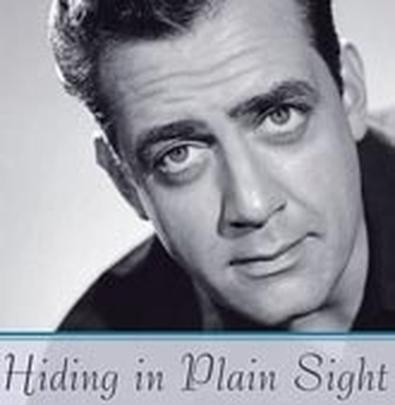
Hiding in Plain Sight: The Secret Life of Raymond Burr begins with an account of the death of English actor Leslie Howard, whose plane was shot down by Nazi fighters over the Bay of Biscay in World War II. Author Michael Seth Starr then tantalizes the reader with the statement, "One young actor in particular took special notice of Howard's death. It would come in handy later on." And that's as imaginative as this dogged biography of actor Raymond Burr gets.
As the title indicates, the hook of this book is that Burr was gay but successfully hid that fact from the public for his entire life, despite having a committed relationship of nearly 36 years with former actor Robert Benevides. It's certainly an interesting situation, but Starr does nothing but repeatedly state it, as if that were sufficient to keep the reader engaged. There's virtually no exploration of the secret life of Starr's title. How did Burr feel about being a gay man in a homophobic culture and industry? What price did he pay for hiding his true self while fabricating extensive lies about tragically deceased wives and children? How did he manage to sustain a successful gay relationship for so long despite the secrecy entailed? How did Benevides feel when Burr's 1993 obituaries repeated all the heterosexual fabrications of his past? You won't find the answers here.
Instead, Starr offers a dutiful chronological account of Burr's public life and career, beginning with a brief look at his early years as the child of a broken home and segueing to his beginning days on the Broadway stage, his success as a supporting character actor in Hollywood films, and his eventual transformation into an American icon on TV, first as Perry Mason and then as the wheelchair-bound detective Robert T. Ironside. Undoubtedly he was a talented actor (check out his performances in the films A Place in the Sun and Rear Window), but Burr's career is nevertheless more notable for the success it brought him than for the work he did, which may be why Starr spends little time analyzing the actor's craft.
Burr had enough success to allow him to buy his own island in the South Pacific in 1965, where he could retreat between roles. And one comes away from this book convinced that Burr was an intensely private sort who would approve of its opacity. Tellingly, though Benevides cooperated with Starr and is even quoted throughout, there isn't even one picture of him among the many photos displayed, most of which feature Burr at work. Burr may not have been able to sustain the illusion of heterosexuality after his death, but he has still taken the real Raymond Burr to the grave.